
A Comprehensive Vision for Long Beach’s Work on AI
A Coalition member shares their approach to creating an AI strategy for their agency, and offers tips for peers at other organizations.

By Małgorzata (Małgosia) Rejniak
When I joined the City of Long Beach as Program Manager for AI and Data Governance a year ago, my focus wasn’t on deploying flashy AI tools or chasing the latest technical buzzwords. It was on articulating a clear vision for how the City should approach artificial intelligence (AI) responsibly, thoughtfully, and in a way that earns public trust.
I envision a future where AI meaningfully enhances how Long Beach delivers public services. It’s a future in which residents from all backgrounds are informed and empowered to shape AI’s use, confident that their data is protected and bias is actively addressed. It’s also a future where City staff feel supported using these tools to work more efficiently and creatively. Ultimately, it’s about ensuring that AI in Long Beach serves people, not the other way around.
Turning that vision into reality requires more than aspiration - it requires a plan. That work became the City of Long Beach AI Strategy, our first comprehensive roadmap for how the City can use AI while remaining grounded in community values.
Four Key Strategic Initiatives
Knowing how to approach AI in government can be daunting, given that it’s often framed as fundamentally different from prior technologies. Early on, I made a deliberate decision to treat AI not as an exception, but as a program to be managed.
Drawing on my experience leading strategic initiatives for the NYC Open Data Program, including implementing the Next Decade of NYC Open Data strategy and provisions of the NYC Open Data Law, I applied the same core principles that guide other well-run public programs: strong governance, staff readiness, and meaningful public engagement. What resulted are four key strategic initiatives applied in the context of AI:
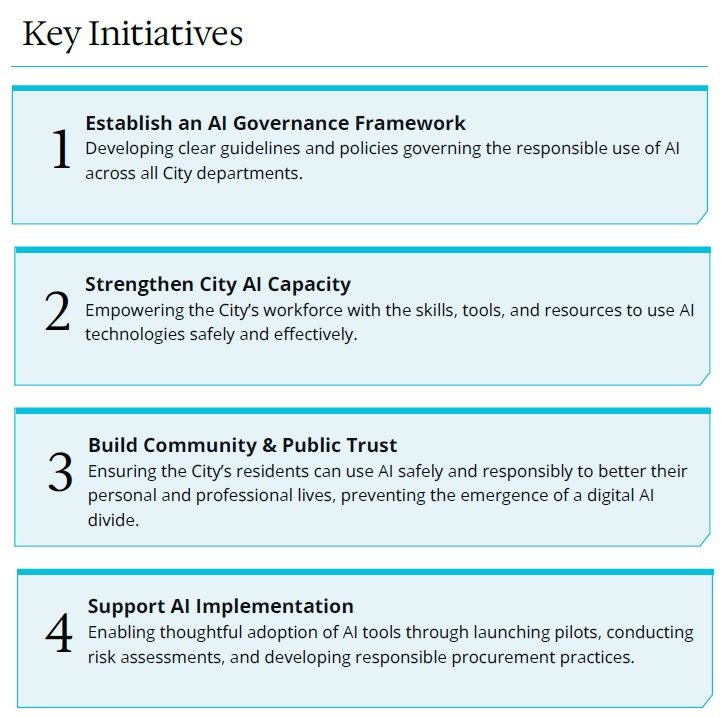
This framing also helped demystify AI internally. Rather than asking ourselves to “figure out AI,” we focused on more grounded questions: How might Long Beach residents benefit from AI and how might they be harmed? How are we equipping City staff to use AI safely and responsibly? What problems are we trying to solve and are they best addressed with technology or with more human-centered approaches?
A Roadmap with Clear Signposts
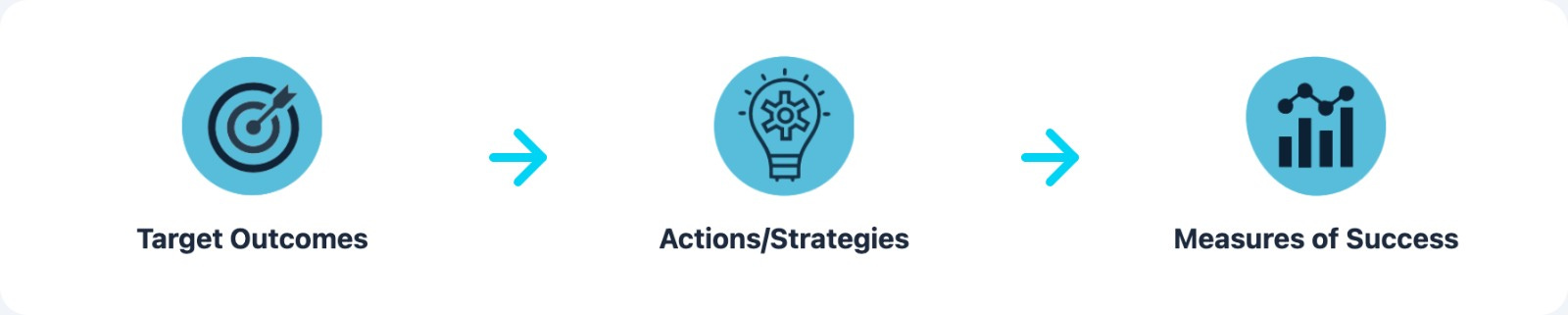
From there, the work became about building a roadmap - one that articulated not just what the City hoped to achieve with AI, but how we would get there, and how success would be measured. That’s why each strategic initiative pairs clear goals and target outcomes with concrete actions and specific measures of success. Because accountability matters and good intentions alone aren’t enough.
What I’m most proud of is how explicitly the strategy defines progress. I took time to develop and gain feedback on the measures of success - often the least visible but most critical part of strategy work. I wanted them to be realistic, meaningful, and tied directly to the vision, so that every goal has a way to track progress and adjust course if needed.
Operating at that translation layer, where strategy meets reality, is where I do my best work and have seen the greatest impact. Across different roles, I’ve learned that articulating a vision is only the starting point; breaking it down into concrete actions, milestones, and metrics that teams can actually rally behind is what allows ideas to materialize.
So whether it’s launching an AI Policy Implementation Committee, piloting staff productivity tools, publishing a public-facing AI website, or integrating environmental impact into AI procurement, the focus throughout the strategy is the same: turning values into practice.
Priorities for 2026: Implementation, Done Right
Looking ahead, my primary focus for 2026 is implementing AI tools that meaningfully improve public services and help employees spend less time on repetitive tasks, and more time on creative, impactful work.
Doing this well is difficult.
It’s easy to let vendors drive AI adoption. My inbox is full of pitches. It’s also tempting to replicate solutions other cities are using, especially when leadership is excited about AI and success stories travel fast.
But just because a tool worked somewhere else doesn’t mean it will work in Long Beach, or that we’re even facing the same problem. And just because a vendor has worked with dozens of municipalities to-date, doesn’t mean they’ll be around in five years, especially given the crowded and competitive AI marketplace.
For me, vendor- or hype-driven AI adoption isn’t the right approach. For me, the real question is: How can I identify challenges where AI holds promise in a way that’s community-driven, not vendor-driven? How do I do that at scale? Even if it takes longer, I want to do it thoughtfully and I want to do it right.
That means starting with the pain points people are actually experiencing, within City departments and across the community. It means identifying where AI might help only after the problem is clearly defined, rather than leading with the technology itself. And it means ensuring that every pilot has real departmental champions - people who are invested in testing solutions and empowered to guide what comes next.
It also means being disciplined about measurement. I plan to develop actionable metrics for evaluating AI pilots, such as time saved, cost reductions, qualify of life gains, and service improvements, while recognizing that success will look different depending on the use case. I’ll be sure to share updates as this work evolves.
Progress So Far
While the strategy sets a long-term direction, the City has already made meaningful progress.
On the community side, and in partnership with the Technology and Innovation Commission, we launched Long Beach’s first Generative AI Community Survey in Summer 2025 to ground our work in resident perspectives. One question asked residents how informed and comfortable they felt about the City’s use of AI. The responses revealed not just an information gap, but a trust gap, underscoring the need for clearer communication and deeper engagement.
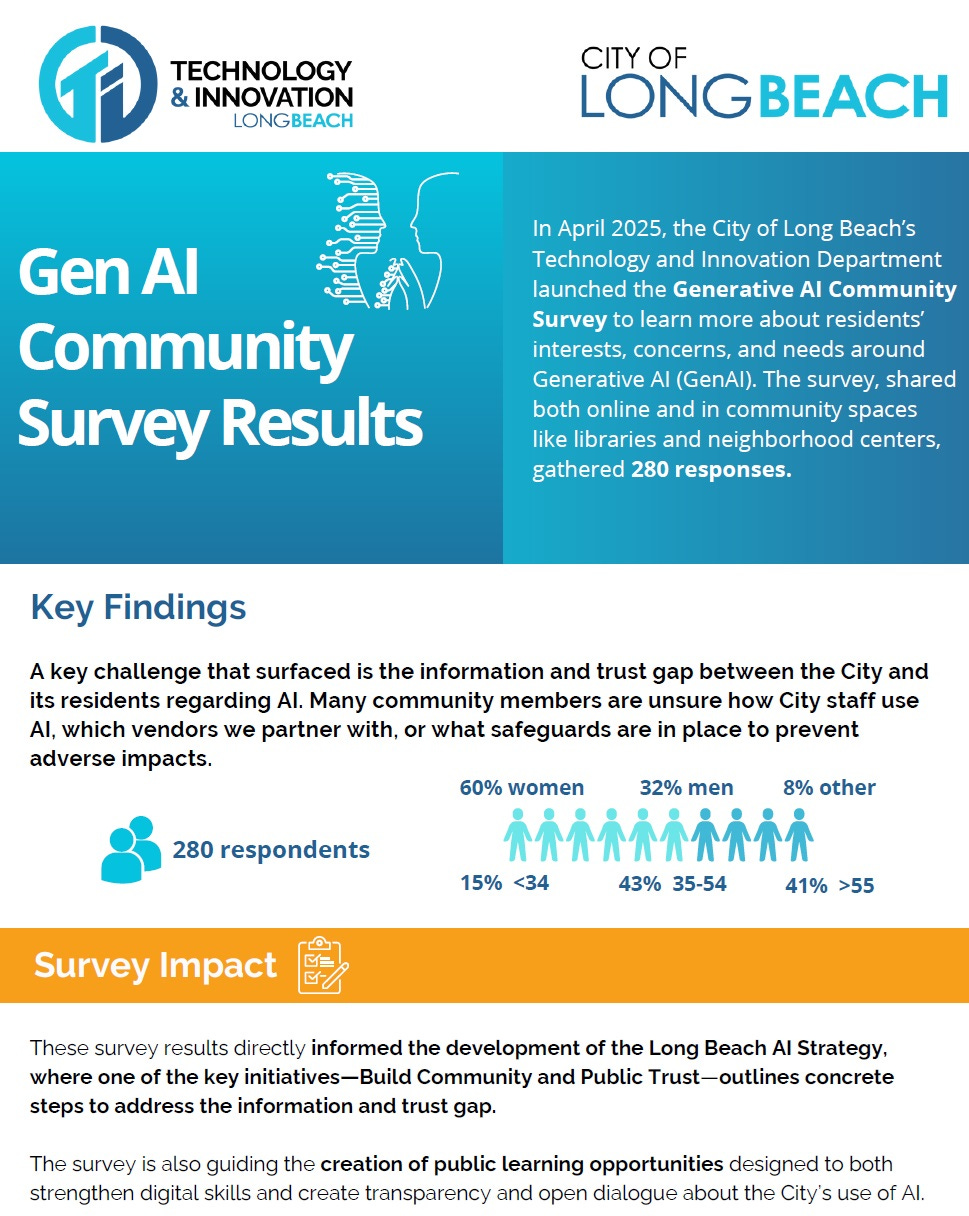
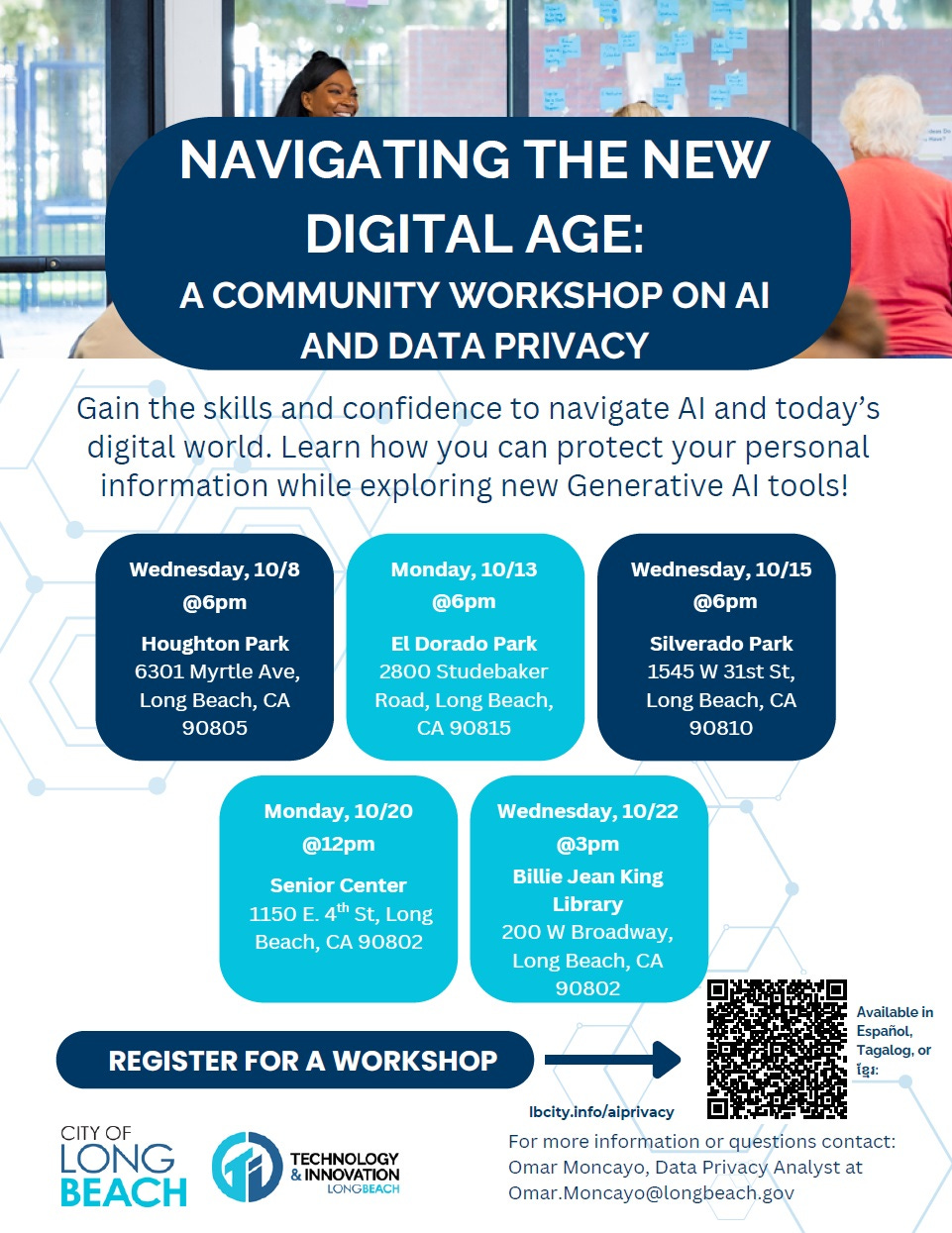
In response, in Fall 2025 we launched a series of free community workshops titled “Navigating the New Digital Age,” focused on generative AI, digital skills, and data privacy. The sessions gave residents practical tools and confidence to engage with the technology, while also explaining how the City is using AI and what safeguards are in place. In 2026, we will carry this momentum forward and offer workshop tailored specifically to the needs of older adults under a California Advanced Services Fund (CASF) grant.
Why This Work Matters Beyond Long Beach
Long Beach is, of course, not the only government grappling with how to thoughtfully approach AI. But today, relatively few cities have published comprehensive AI strategies that bring together governance, workforce readiness, public engagement, and implementation support in one place.
My hope is that this strategy doesn’t just serve Long Beach, but that it offers a practical framework for other cities beginning their own AI journeys. Not a one-size-fits-all model, but an example of how local governments can approach AI thoughtfully, incrementally, and with public trust at the center.
Because the real challenge isn’t whether governments will use AI, it’s how they choose to do it. And getting that right matters far beyond any single jurisdiction.
About the Author
Małgorzata (Małgosia) Rejniak is the Program Manager, AI and Data Governance for the City of Long Beach.
Note: The opinions expressed in these articles are solely those of the author(s) and do not necessarily reflect the views, positions, or policies of the GovAI Coalition or the authors’ affiliated professional organization(s).
—
This is the blog for the GovAI Coalition, a coalition of local, state, and federal agencies united in their mission to promote responsible and purposeful AI in the public sector.
